
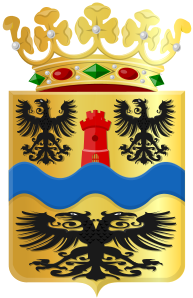
The Headless Calf of Arnemuiden


On Walcheren, where the land leans against the old river Arne, stands Arnemuiden: a little town of fishermen, traditional dress and bells that never fall silent. Once hundreds of merchant ships lay at anchor here and the town counted more inns than Middelburg. Then the harbour silted up, and the sea that had made Arnemuiden great withdrew. What remained was a community that floated on the ghost stories of its fishermen like a sloop on the tide. They are preserved in the Dutch Folktale Database, written down from the mouths of Arnemuiden people themselves: the headless calf on the mooring post, the fish that nobody saw, and the bells that, according to the neighbours, know only one song.


1 The harbour that vanished
Arnemuiden is older than its streets. The first little town of that name, mentioned as early as 1223, was swallowed around 1440 by the Arne itself; a second Arnemuiden also disappeared into the water. Only around 1462 did the present town rise, and it knew a short, dizzying prosperity. The roadstead lay strategically between the Baltic, France and England; in 1496 one hundred and thirty-five ships lay at anchor at once, and in 1570 four hundred salt ships alone called at the harbour. There were more inns then than in Middelburg.
It cost Arnemuiden dearly that it chose early for William of Orange in the Eighty Years War: on 8 May 1572 the Spanish troops of Sancho d’Avila plundered the town and hundreds of citizens died. Two years later the prince rewarded its loyalty with town rights. But the sea is no ally that lets itself be held. In the seventeenth century the harbour silted up beyond recall, the great ships stayed away, trade and shipping fell still.
And then, so the neighbours on Walcheren told with a grin, the bells of Arnemuiden began to toll their own poverty. Once Arnemuiden was a rich merchant town, so Sinninghe recorded the mocking legend, but since the harbour silted up the bells know only one song, which they repeat without end: arme luie, arme luie, poor lazy ones. And whoever wanted to tease the people of Arnemuiden called them Strontkruiers, dung barrowers, after the manure they wheeled across the meagre fields.
2 The calf without a head
Whoever no longer has a harbour fishes farther out, and whoever puts to sea in the dark meets more on the way than fish. In 1962 the collector J.M. de Nooijer wrote down, from the mouth of the Arnemuiden man A. Grootjans, a series of ghost stories that were told on the fishing fleet. The best known takes place at the wharf of Arnemuiden itself. There lay a sloop, no ordinary rowing boat but a heavy vessel with five men aboard, drawing a good ten feet.
On a Monday morning, before first light, the crew wanted to sail. The skipper called that the ropes could be cast off, but the hand who had walked forward came back pale: on the foremost mooring post stood a calf without a head, beating the wood with the stump of its neck. The whole crew saw the beast standing there, and nobody dared go near. The skipper called a council of war, and they threw dice for who must cast off the ropes: whoever threw the fewest pips had to go.
The lot fell on the fourth man. He fetched the bread knife from the table drawer, walked over the plank to the shore, straight up to the mooring post, and cried: in God’s name. At that single word the calf gave a jolt and was suddenly gone. The hand cast off fore and aft, and the sloop sailed to Veere to go fishing. For more stubborn ghosts, all Arnemuiden knew a remedy besides: a ghost shot with a silver bullet or silver shot was dead for good and never troubled anyone again.
3 Bewitched on the Arnemuiden path
Between Arnemuiden and Middelburg there once ran the Arnemuiden path, a footway straight across the land, with little planks over the ditches and here and there a drinking pit for the cattle. Along it went the fish hawkers, who carried baskets full of fish to town. One evening, towards five, one of them sold his last lot of fish to a Middelburg woman and said that he would now make sure he got home. Well, said the woman, then you will not be home for a while yet.
On the path, by a drinking pit, the track deserted him. Instead of walking straight on he walked around the pit, the whole night long, without growing tired and without finding the path again. Only when day broke did he suddenly stand on the path once more, and the spell was broken. At home his worried wife understood at once what he himself already knew: the woman from Middelburg had bewitched him.
Another couple heard fresh fish slapping with tail and fins on the tiles of the back house through a whole Saturday night; there was nothing to be seen, and when they went to look at first light, not a trace of fish slime lay anywhere. And the children? They were warned about Ooszepik, also called Jan Haak, the water devil who dwelt in wells and in the canal and pulled you down by the leg if you went swimming alone. Thus Arnemuiden kept its people together: with bells, with ghosts, and with a watchful eye on the water.
- The Treasure of Serooskerke · Serooskerke
- The Witch of Veere · Veere
- The Painting of Our Lady of the Polder · Vrouwenpolder

Heimweer.be · Europees Erfgoed Bewaard

