
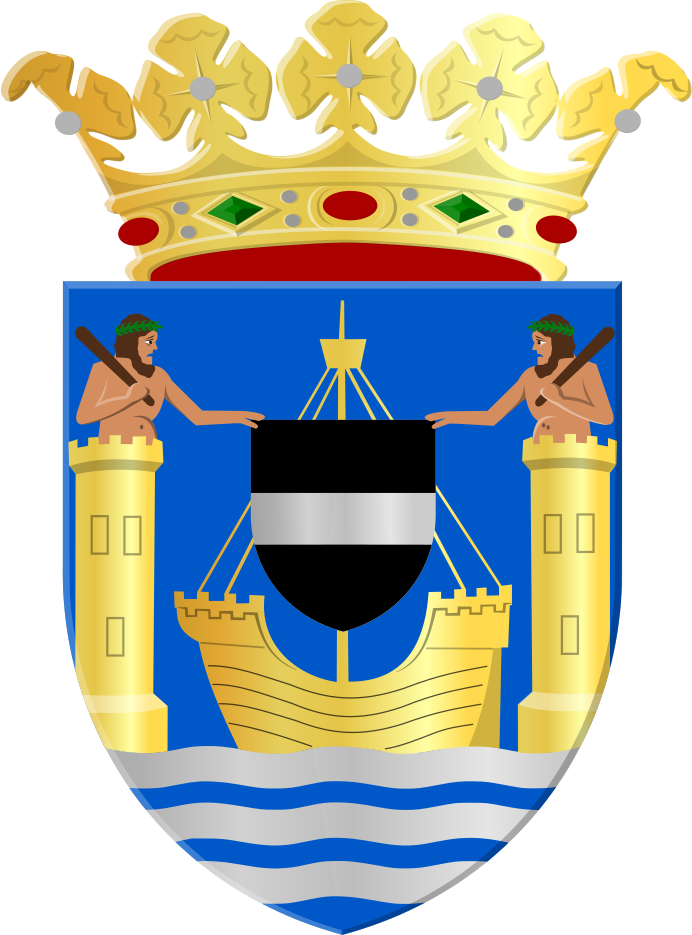
The Witch of Veere


Veere lies on the Veerse Meer, which until 27 April 1961 was called the Veerse Gat and lay open to the North Sea. Anyone arriving today sees a little town of barely two thousand inhabitants with a town hall that looks built for a capital and a church whose tower stopped halfway up. And beneath those facades lies a story set down in black and white in 1933 and 1934: about a woman who rode a bundle of straw across the surf, who sent ships to the bottom, and whom the judges of Veere had burned alive.


1 The town that lived by the ferry
Veere began as the hamlet of Kampvere or Ter Veere, a small harbour in the manor of Zandijk, and owes its name to the ferry that crossed the water here. The oldest mention stands in a charter of 1282, in which Wolfert van Borsele and his wife Sybille hand over possessions to Countess Beatrix, wife of Count Floris V, among them Zandenburg castle and the harbour.
What came next came quickly. In 1444 Wolfert VI van Borselen married Mary Stuart, daughter of King James I of Scotland; she died in 1465 as marchioness of Veere. In 1541 Veere became the staple port for Scottish wool in the Low Countries, and that made the town rich. Around 1600, three hundred of its three thousand inhabitants were Scots, with their own governor, notary and judge.
That money went into building. The town hall on the Markt was raised between 1474 and 1477 under the Fleming Everaert Spoorwater; its facade carries the statues of four lords and three ladies of Veere. The church of Our Lady of the Snows was laid out on such a scale that it was never completed: the west tower, meant to rise more than a hundred metres, stuck fast at fifty-two.
2 The woman on the wisp of straw
In 1934 S. Franke included in his collection Legenden langs de Noordzee a legend he called simply The Witch of Veere. He refuses to give her name; whoever wants to know it, he writes, may look it up in the chronicles. She kept company with the devil, who in these parts is called Joost. She was still young and comely then, he promised her much, and she could not resist the temptation.
From that day she understood the black art. With a salve the evil one had given her, she could drift on a bundle of straw at sea without drowning. Whole nights she drifted so upon the raging waves, by preference when it stormed, and woe to the fisherman who came near her. Off Westkapelle she sent a ship with forty-five men aboard to the bottom. Unmoved she sat on her wisp of straw and watched, and her laughter rattled out above the violence of the waves and the howling of the storm.
The chronicles Franke points to genuinely exist. The Zeeuwsch sagenboek of J.R.W. and M. Sinninghe of 1933 gives the trial records. In 1565 an elderly woman stood trial at Veere: Digna Robberts, commonly known as Water and Bread. On the rack she confessed that thirty-five years earlier she had been sitting eating at a heul, a little bridge halfway between Middelburg and Veere, when a young man dressed all in black promised her gold and silver for her soul, and offered besides to teach her how to send ships down on the open sea. She only consented when he threatened to grind her to dust. As a token of the pact he took away a braid of her hair.
3 As an example to others
Some months later a second woman stood trial at Veere: Geertruid Willems, thirty-three years old, and according to Zeeuwse Ankers from Zanddijk. Driven by poverty she had gone to her sister at Arnemuiden, who refused to help her and snapped that she should work for her bread. Halfway along the dike she let herself drop hopelessly into the grass, and there Satan came to her as a handsome young man in a short cloak and a black hat. From her too he took a braid of hair as a pledge, and she too received a wonder salve, with which she made Aagje, the maidservant of Leuntje Blaas, lame and crippled. She offered to heal Aagje within fourteen days if they would set her free. The court did not take up the offer.
Both women were sentenced to be burned alive, in the formula of the verdict: until you shall have passed from living body unto death, and your body shall remain standing there as an example to others. Digna Robberts was burned that same afternoon.
The town that passed such sentences then slowly vanished from the world itself. In 1795 all the rights of the Scottish colony lapsed. In 1809 the English bombarded Veere from the sea; when Napoleon afterwards fortified the town, more than three thousand French soldiers were nursed in the Great Church in 1813 and 1814, of whom over fourteen hundred died. From 1822 to 1826 it served as a workhouse for beggars. In 1861 the garrison was disbanded, and in 1961 the Veerse Gatdam shut out the sea. Only the carillon in the town hall tower still plays, and above it hangs the bell that Peter II van den Gheyn cast in 1594 and that still strikes the hours there.
- The Painting of Our Lady of the Polder · Vrouwenpolder
- The Headless Calf of Arnemuiden · Arnemuiden
- The Treasure of Serooskerke · Serooskerke

Heimweer.be · Europees Erfgoed Bewaard

