
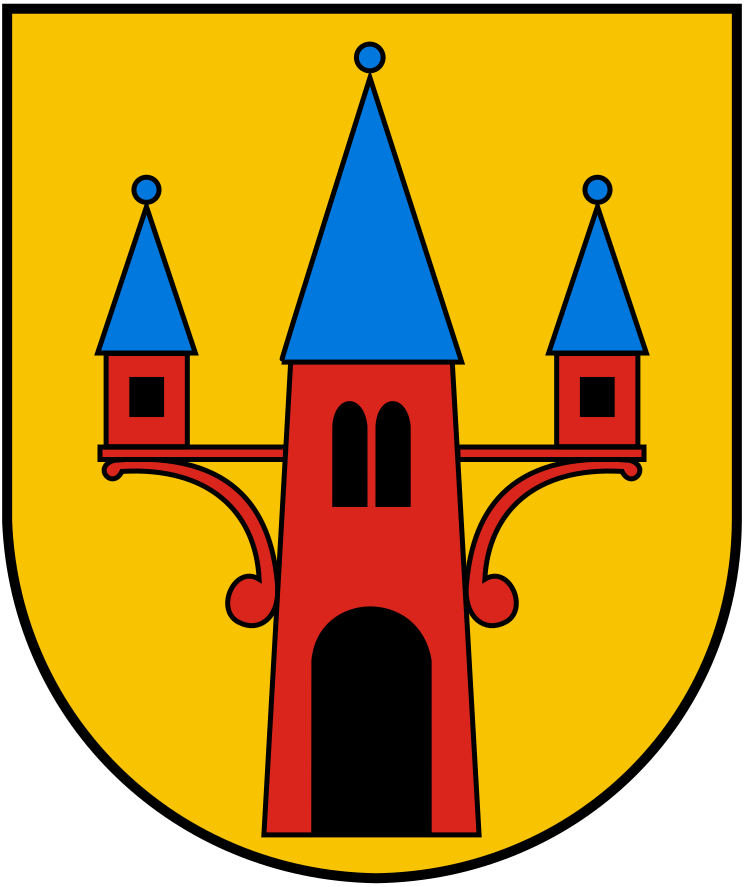
The Golden Apple of Nakło


Nakło (Nakel) lies on the Noteć (Netze), in a broad, wet valley full of reedbeds and marshy ground. In the days of Duke Bolesław Krzywousty, Bolesław Wrymouth, it was one of the chief strongholds of the Pomeranians. Jan Długosz, the great chronicler of Poland, tells how the Polish army came before its walls, and who led it there.


1 A youth on the church
Bolesław Krzywousty had already dealt the Prussians and the Pomeranians heavy defeats. Yet he thought they had not learned enough. He gathered his troops at Kruszwica, by Lake Gopło. The camp was full of tents and fires, horses whinnied on their tethers, and the men made ready to march.
The army was just about to move off when, in broad daylight, something happened that nearly every soldier saw with his own eyes. On the very top of the church of Kruszwica there appeared a fair youth, in white robes that gleamed and glittered in the light.
Everyone stood still and stared up. No one had seen him climb, no one knew who he was. While they were still gazing in wonder, he leapt down from the church and stepped out before the banners, like someone who knew exactly where he had to go.
2 The road to Nakło
Then the whole army struck camp at once, full of joy. Behind that leader, given by God, they hurried on, already promising themselves a glorious victory over the enemy. No one spoke to him, no one asked him anything. They simply followed the white robe that went before the banners, along the roads and through the forests, northwards.
The land grew lower and wetter the further they went. The roads ran along little dykes between the reeds, the carts sank into the mud, and in the evenings the mist hung low over the meadows. But no one complained, for up ahead there still went that white figure, and where he went, the army followed.
So they came to Nakło. In those days it was the foremost town of the Pomeranians or Kashubians, strong by nature thanks to where it lay, between water and marsh, and well fortified by human hands with ramparts and palisades.
There the youth stopped. He held a golden apple in his hand. He threw it towards the town, and in that same moment he vanished. Where he had stood there was nothing to be seen but the grass and the army behind him.
3 At the walls
Now the Poles struck with all their might. Some of them set ladders against the ramparts and tried to scale the walls, others battered the gates to break them open. Arrows flew back and forth, stones fell from the parapet, and all day long the shouting rang out over the Noteć.
They came within a hair of taking the town that very day. But it did not happen, the chronicle says, because a still more complete victory over the unbelieving enemy awaited them.
And that victory came. The historians record that on 10 August 1109, at Nakło, Bolesław defeated the Pomeranian army that had come to relieve the besieged town, and that Nakło surrendered afterwards. The golden apple had done its work.
- The Burnt Tower of Chełmno · Chełmno
- The Girl with the Rake near Brześć Kujawski · Brześć Kujawski
- The Nine Groschen of Bydgoszcz · Bydgoszcz

Heimweer.be · Europees Erfgoed Bewaard

