
The Heraldic Bull of Monnickendam


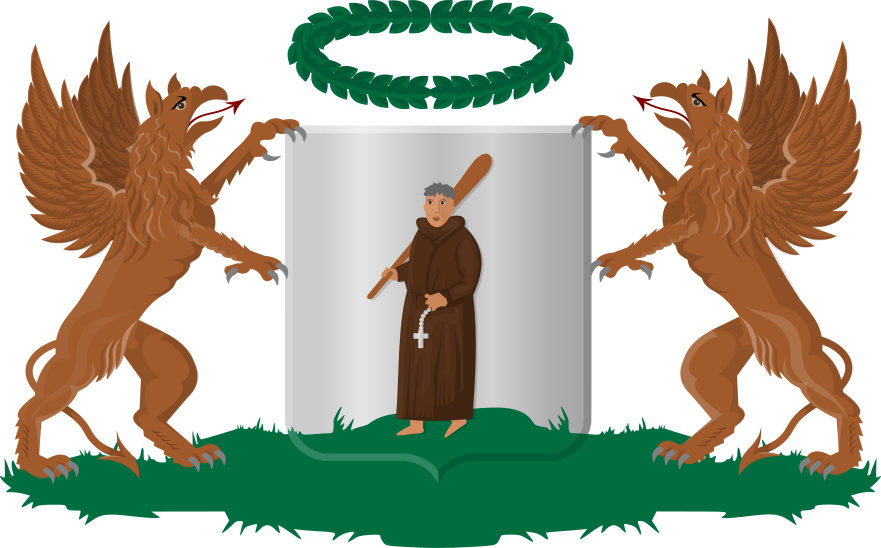
On the Gouwzee, where Waterland gives way to the Markermeer, lies Monnickendam: a small harbour town with a church tower fifty-five metres high and a Speeltoren holding the oldest hand-played carillon in the world. Its arms carry no ship, no herring and no cheese, but a monk standing on green ground with something in his hand that looks like a club. Why he stands there nobody knows for certain. Yet in Waterland and West Friesland people have told a story about him for centuries — a story that does not end with one coat of arms, but with five.


1 The bull on the monastery roof
It begins, tradition says, in the monastery of Monnickendam. A bull was kept there, and that bull had stripped the monastery meadow bare in a day and a half. The prior could no longer get round to saying his breviary: he kept thinking about the animal and about what it would eat the next day. When he raised his eyes to heaven, as becomes pious men, his gaze fell on the roof of the monastery. Grass was growing there.
The decision was quickly made: the bull had to go up. The monks slung ropes around the animal and began to hoist. As long as its hooves touched the ground all was well, but the moment the bull came loose from the earth it began to thrash and bellow, and it hung against the wall roaring as though the monastery were coming down. The brothers pulled until their arms cracked. Then the rope broke. With a thud like a falling tree the bull stood on its own legs again, and the monks lay tumbled every which way.
One of them scrambled up, seized a club and set off after the beast. Stop him, he cried, stop him! A farmer along the road paused and asked what the bull had actually done wrong. To that the monk had no answer. Nobody helped, and the bull got away. By way of consolation, so the story ends, they put that monk with his club into the arms of Monnickendam. There he stands to this day.
2 From Edam to Hoorn
The bull was loose in Waterland by now. It charged along the Hogendijk and the Purmer and reached Edam towards evening, where it spent the night in a wide meadow. Before sunrise a dairyman came past who thought he saw a man in the dark and asked what he was doing there. The bull, which knew only a single word, growled: stars. When the man later understood whom he had addressed, he told the burgomaster — and so Edam received a bull on a green field with three golden stars above it.
In Middelie the people stayed indoors and the animals fled into the scrub. Only the frogs along the ditch called after him that he was plain mad. The aldermen of Middelie, who otherwise rarely came outside by day, thought this so well put that they had three frogs painted in their arms. In Oosthuizen only old Marijtje could not curb her curiosity. She went out into the street with her spectacles in her hand, took a blow from behind and flew through the air; she was found with her head through the bridge railing and her cap over her eyes. In her hand she still held her spectacles, with one lens missing. That pair with the loose lens has stood in the arms of Oosthuizen ever since.
In Beets, Oudendijk, Grosthuizen and Berkhout nobody saw him at all. The next morning he rammed the gate of Hoorn. When the townspeople dared into the street, they saw him just leaving the town at the far end — and a broken horn was stuck in the gate. The bailiff decided that horn belonged in the town arms, for Hoorn had none yet.
3 The town beneath the monk
It is a legend, not history. Heraldists point out that before the monk Monnickendam used a wholly different seal: the oldest, from 1361, shows a swan with small crosses after the arms of the Persijn family. Only on a seal of 1406 does the monk appear, and on a version of 1625 the club is still absent. The arms as they now stand were officially granted on 26 June 1816: on silver a monk in natural colour, standing on green ground, held on either side by a griffin.
A monastery there certainly was. Around 1400 a house named Mariëngaarde rose beside the Great or Saint Nicholas Church, the same name as the Frisian Premonstratensian abbey whose monks, by one explanation, gave the town its name. By another explanation, the small stone turrets built on dams were simply called monks. Monnickendam is first mentioned in 1288 and received its charters from Count William V on 25 February 1355. Two town fires, in 1499 and 1513, left little standing but the church.
What survived is still there. The Great or Saint Nicholas Church, whose choir was finished in 1450 and whose tower rose between 1510 and 1550. And the Speeltoren on the Noordeinde, with its wooden crown of 1591 and 1592; fifteen bells hang in it, largely cast between 1595 and 1597 by the Mechelen bell founder Peeter van den Ghein II. On every full hour the sixteenth-century clockwork sets a procession of horsemen in motion and a winged Fame sounds the hours on her trumpet. On the lock bridge by the weigh house stands a monk by the town artist Rob Cerneus — without a bull, but with the look of someone who has lost something.
- The White Dog of Marken · Marken

Heimweer.be · Europees Erfgoed Bewaard

