
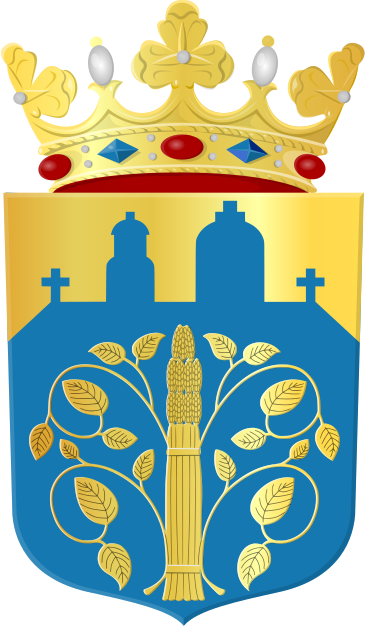
The Vanished Apostles of Ter Apel


In the far south-eastern corner of Groningen, where Westerwolde leans against the German border, the monastery of Ter Apel lies among centuries-old oaks. Of the more than thirty monasteries that Town and Ommelanden once counted, it is the only one preserved, and it is held to be the only medieval countryside monastery of north-western Europe still standing. Whoever walks through the vaulted cloister hears his own footsteps linger. But for generations the people of Westerwolde have said that there is more beneath those floors than foundations: a bricked-up passage, and in it, perhaps, fourteen statues that have been missing without trace since the Reformation.


1 The House of the New Light
In 1464 Jacobus Wiltingh, parish priest at Garrelsweer and vicar at Loppersum, gave his settlement of Apell to the Order of the Holy Cross, on condition that a monastery should rise on the spot. The General Chapter of the Crosier Fathers, meeting at Huy on the Meuse in May 1465, accepted the gift as a godsend and appointed Saint Gertrude’s at Bentlage on the Ems as mother house. Four priests and a few lay brothers travelled from there to Westerwolde. Their new house received a name full of promise: Domus Novae Lucis, House of the New Light.
The building took nearly a century. In 1472 a fire destroyed chapel, refectory, dormitory and kitchen, but the Crosiers began again; only 1561 stands as the year of completion above the north wing. Around the convent rose a gatehouse, water mills, a parchment house, a bakery and brewery and a guest house, for the monastery lay on the old trade route from Münster to Groningen and every traveller was welcome to catch his breath there.
About that building Westerwolde tells its first legend. A prince of the church is said to have promised the country folk a full indulgence if they helped, and from Valthe to Ter Apel the people are said to have stood in one long line, passing the monastery bricks from hand to hand, hours across the bog.
2 The passage nobody dared leave open
In the choir of the monastery church once stood the statues of the twelve apostles and two prophets, and between them, on a corbel of its own, an image of Mary with one foot on the crescent moon and a halo of rays behind her. Government architect C.H. Peters still described the carving with admiration: everything chiselled as delicately as lace. But when William Louis of Nassau conquered Westerwolde in 1593 and the Reformation was carried through, the monastery fell to the city of Groningen. The last prior, Johannes Emmen, went over to the new faith and stayed on as administrator until 1603. And somewhere in those troubled years the fourteen statues disappeared. Nowhere is it recorded where they went.
Tradition knows more. Travellers from Winschoten who visited the monastery in 1817 noted that in the cellar they saw an underground passage, closed with a door, so that no one could enter it. When that passage was opened around the middle of the nineteenth century, the workmen, by their own firm account, suddenly saw people or ghosts before them. They dropped crowbars and picks, fled, and walled the passage up again as fast as they could.
Since then Westerwolde has held that one of the last priors hid the apostles in the passage to save them, and never got the chance to fetch them back. When music sounds in the walking woods, it is heard with striking clarity in certain rooms of the monastery, and the old people used to say: that is the passage.
3 What remained of the light
The centuries after the Reduction were not gentle to the House of the New Light. The west wing was demolished after 1755, in 1834 the upper floor with the cells of the Crosiers followed, in 1837 wooden ceilings replaced the crumbling rib vaults of the church, and in 1884 the nave was even degraded to a store and carpentry shed. What remained served as church, parsonage, school and poorhouse.
Only between 1930 and 1933 did the tide turn, when the city of Groningen had the complex restored under city engineer De Vos tot Nederveen Cappel. In 1976 the city transferred monastery and woods to the State for a symbolic guilder, in 1988 the convent building became a museum of monastic and church history, and in 2001 the square regained its west wing, newly built to a design by the Danish architect Johannes Exner.
The apostles have never been found. But the tradition unexpectedly received support from scholarship: building-historical research from 2021 considers it likely that an older monastery already stood here in the thirteenth century, Domus Verae Lucis, House of the True Light, whose rubble is thought to be built into the walls of the present building. The old story that more lies hidden beneath Ter Apel than meets the eye thus proved at least partly true. Whoever walks the cloister today and hears music somewhere may decide for himself where the sound comes from.
- Engel Pomkeblad, the Aulk of Onstwedde · Onstwedde
- The Witch Hunt of Wedde · Wedde

Heimweer.be · Europees Erfgoed Bewaard

