
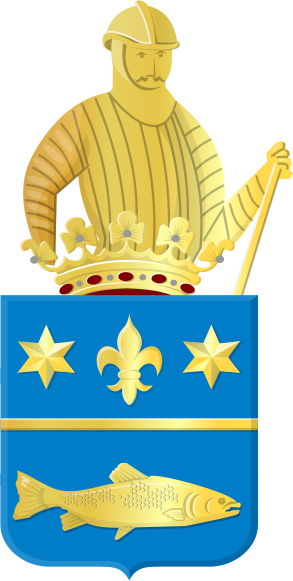
The card-playing devils of Genemuiden


Where the Zwarte Water makes its last bends before vanishing into the Zwarte Meer lies Genemuiden: a town of just over ten thousand people that owes its name to a river mouth and its bread to a grass-like plant. For centuries the men here stood chest-deep in the outer water cutting rushes; at home the women and children wove them into mats. Yet when the Meertens Institute asked in 1954 which stories the people of Genemuiden knew, the answer had nothing to do with rushes. It was about the devil — in the attic, on the dyke, and playing cards in the middle of the bridge.


1 Four devils on the Molenbrug
On 6 September 1954 folklore questionnaire 18 of the Meertens Institute was filled in at Genemuiden, form F084p. The first question read: do you know stories about people who have seen the devil or had dealings with him? The respondent wrote down five. They stand today in the Dutch Folktale Database under the numbers LIJST115 to LIJST119, all five with Genemuiden as their place of action.
The longest is called «De kaartende duivels», the card-playing devils. There used to be an inn on the Meulebelt, and things could turn wild there of an evening when the lads of Genemuiden came to play cards and drink. There was swearing, there was mockery of the holiest things, and now and then the knives came out of their sheaths. One evening one of the ringleaders drove his knife, cursing, into the thatched roof of the inn — and warm blood dripped out. The mocker recoiled, called his companions, and together they decided to go home. But on the Molenbrug over the Drecht sat four devils playing cards. The lads took the towpath; at the Eindebrugje there were more. Mad with fear, the drunkards jumped into the water and waded through the Drecht to escape the teeth and claws.
The other four stories are shorter and more domestic. A certain Baaje saw the devil twice in his attic: first as the skeleton of a rat, later as a goat eating his red cabbages, which vanished the moment he struck at it with a piece of wood. The same Baaje heard music coming out of the water at night, singing that he would not get through his own door that night, and then met an enormous bear in the middle of the Platteweg. Toon was given a beating in the dark by the canal, by nobody at all. And Merten Duveltien owed his nickname to a big dog that bit him on the Sasdijk until he was completely sober.
2 Chest-deep in the outer water
Rushes had grown around Genemuiden since the sixteenth century, and from the seventeenth their working became the foundation the town floated on. What that labour looked like was written down in 1962 in the Collectie Ampt of the Meertens Institute. At the end of July the rush cutters stood at three in the morning in the outer water of the Zuiderzee: clogs on against the sharp reed stems, waist-deep in the water, chest-deep when the tide came in. They cut with a hooked blade, loaded the bundles into a flat-bottomed punt, and let the wind dry their clothes on the way back to shore.
Ashore the rushes were bound, spread out and left five or six weeks in the sun; children raked them together again with a stick and a nail. The carter Post earned sixty cents per hundred bundles. Anyone who could not pay the rent on his rush plot went to Germany in October for navvy work, selling his share in the common pasture to pay for the journey. The Association of Great Burghers owned seventy-five hectares of rush land outside the dyke; at the letting, the plots were inspected from rowing boats and bids ran between fifty and two hundred and twenty guilders.
Around 1910 the town began weaving mats: carpets, runners and above all the block mat, the Genemuiden mat. The first small factories appeared in 1918 and 1919. After the war came the coconut mat — by 1950 a third of the working population was already in that industry — and after 1965 soft floor covering. In 2010 more than half of all Dutch wool and nylon carpet came from this one town.
3 Fire, water and the ferry
Genemuiden received its town rights in 1275 from Jan van Nassau, elect of the See of Utrecht from 1267 to 1290; in 2025 the town therefore celebrated its seven hundred and fiftieth birthday. A later bishop, Jan van Arkel, granted it the ferry right across the Zwarte Water in return for a yearly delivery of sixty pounds of wax for candles. In 1382 three annual fairs were added, and the town grew rich enough on them to build a town hall.
Almost nothing of that old Genemuiden survives, for it burned down again and again: in 1625, in 1698, when eighty houses and fifty-one barns went up in ashes, and once more in 1740. Since then a ban on smoking on the public road has applied, still in force on the Achterweg among the hay barracks and unique in the Netherlands. The fires of 1868 and 1882 destroyed the town yet again; in 1868 the entire town archive was lost as well. Buildings older than about a hundred and twenty-five years are hardly to be found.
The water claimed its share on 8 March 1922. During a severe storm the ferry between Zwartsluis and Genemuiden sank; eleven people drowned, among them the mayor and his wife. The wooden ferry was afterwards replaced by a cable ferry, and a ferry still crosses the Zwarte Water today. Whoever crosses it now sees no devils on the bridge — but the Drecht, the Sasdijk and the Meulebelt are all still there, and their names stand in black and white in the Dutch Folktale Database.
- The Chessboard of Zwartsluis · Zwartsluis
- The Holy Place of Hasselt · Hasselt (Ov.)

Heimweer.be · Europees Erfgoed Bewaard

