
The Devil and the Cut Tail of Coaraze

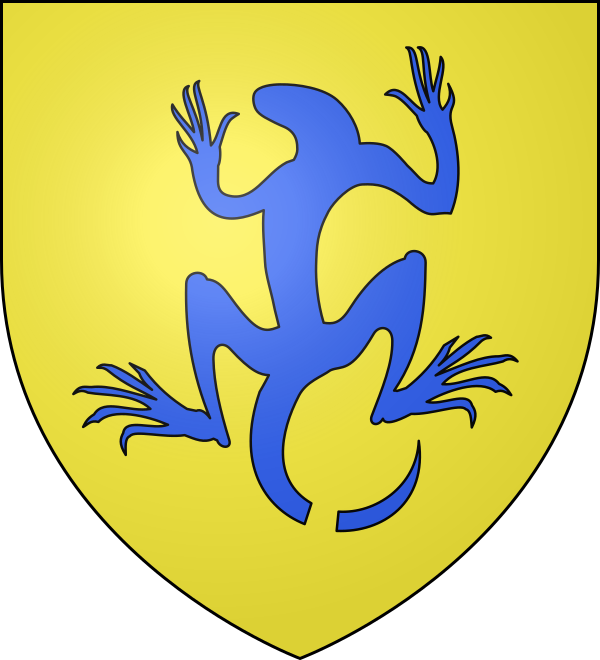
Clinging to its sandstone crag, at the foot of Mont Férion, Coaraze looks out over the valley of the Paillon from six hundred and sixty-seven metres. They call it the village of the sun, and there the hour is read from sundials that artists painted. But before the sundials comes the name, and before the name comes a tiny creature one sometimes finds between two warm stones: a lizard with its tail cut off. That lizard is the arms of the commune, and it got there, they say, in the company of the devil.


1 The village of the sun
The site is old. The basin of the Paillon is thought to have been settled as early as the Bronze Age, in the time when the rocks of the Vallée des Merveilles were being engraved. On the hill stood a castellaras, an enclosure of dry stone, and at the highest point a church and a fortified house. The village huddled around it, in the smallest of spaces, and that order lasted into the eleventh and twelfth centuries. In 1108 a document names it at last: castellum Caude rase. It depended then on Nice, for its administration as for its worship.
The old forms follow one another: Coarasa in 1235, Cauda Rasa in 1256. Ligurians, Celts and Romans had succeeded one another there. On 2 March 1629 Coaraze was raised to a barony; from 1744 to 1748 it knew a Spanish administration, before the road from Nice at last reached the village, from then on served in four hours by coach.
Today Coaraze is counted among the most beautiful villages of France. One climbs from square to little square by lanes sheltered under vaulted passages, along walls of bare stone and façades in warm colours, passing from the cool shade to the dazzle of full sun. It is that sun that earns it its nickname.
2 The devil’s tail
Where does this name Coaraze come from? In Occitan coa rasa means shaven tail, and tradition makes a story of it. Long ago, they say, the people of Coaraze managed to capture the devil. To hold him fast they bound him by the tail with birdlime. The Evil One struggled, pulled, and found only one way out: to cut off his own tail. So he escaped, shorn, and left his tail to the villagers. From that feat the commune is said to have taken its name, coa rasa, the cut tail.
Others tell it differently. Some see in the name the tailless lizard drawn, below, by the meeting of the stream of the Gravière and the Paillon. Others recall that the ancients wore their hair long in the Gaulish fashion, while those of Coaraze had a shaven neck.
And this is where honesty belongs. Scholars lean towards a less charming explanation: the name would come from the Latin quadrata, the square farmstead, later drawn towards cauda, the tail, which becomes coa in Occitan. The legend would then be born of the name, and not the other way round. But Coaraze loses nothing by it, for out of that cut tail it has made its emblem.
3 The hour on the sun
The arms of the commune bear, on a field of gold, a blue lizard rampant with a broken tail: the creature of the tale, graven in the shield. One finds it everywhere in the village, for in 1960 the mayor asked famous artists to paint sundials on the façades, that instrument of the lands of the sun. Jean Cocteau drew one, Les Lézards, carried out in ceramic with Gilbert Valentin. Eight dials were set up, the project was abandoned for a time, then taken up again in 2008; Ben, Sosno, Goetz and Ponce de Léon were added, and today one counts nearly a dozen on the town hall, the school and the church square.
The village keeps other treasures too. A kilometre from the entrance, on the old mule track from Nice, the chapel of Saint-Sébastien was built around 1530 to protect the town from the plague; its sixteenth-century paintings, by an anonymous Nice master, have earned it listing as a historic monument since 2001. Higher up, the Blue Chapel unrolls a monochrome decoration painted in 1962 by Angelo Ponce de Léon, and the church of Saint-Jean-Baptiste hides a baroque interior behind its plain front.
So it goes with Coaraze: a village that reads the hour on the sun and bears, for its arms, the tail the devil left behind.
- The Lemon of Eve and the Feast of Menton · Menton
- The Devil’s Marvels above Tende · Tende

Heimweer.be · Europees Erfgoed Bewaard

