
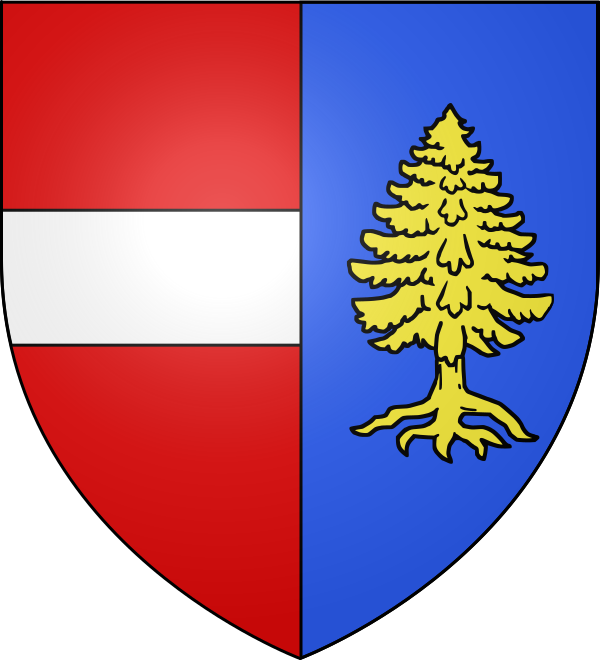
The Crierie of Thann and the Three Firs


Thann stands at the mouth of the Thur valley, where the Vosges open out onto the Alsatian plain. Above the roofs rises the openwork spire of the collegiate church of Saint-Thiébaut, and on the square in front of it three fir trees go up in flames every year on 30 June. The people of Thann call this the Crierie, and they tell you with it how their town came to be.


1 The thumb of the bishop of Gubbio
On 16 May 1160 Bishop Ubaldo Baldassini died at Gubbio in Umbria; in Alsace he is called Thiébaut or Theobald. In his service was a servant who, according to the oldest printed version, came from the Low Countries or from Lorraine and was still owed his wages. The bishop had been so generous that there was nothing left to inherit. When the press of mourners delayed the burial, the servant slipped up to the body and cut away a piece of skin from the thumb. He hid it in his pilgrim’s bag and set off north in haste.
Other versions speak not of a thumb but of a ring. The servant inherits the bishop’s ring, or cannot work it off the stiff finger and takes the finger along with it, hidden in the knob of his hollow staff. Either way he carried a relic over the Alps, through Burgundy and the Sundgau, until he reached the lands of the counts of Ferrette. His road lay up the Thur valley and on into Lorraine.
2 The light above the fir
Before entering the narrows of the valley he lay down to rest in a wood of firs. He planted his pilgrim staff in the ground beside him, leaning against a tree, and fell asleep. On waking he could not free the staff. He pulled, he wrenched, he fetched villagers: the wood would not give, and more and more people gathered.
Meanwhile the lord of the valley, called Engelhard in the oldest tradition and living in the castle of Engelbourg, saw a great light shoot three times from the crown of a fir. He came down, found a crowd around a stranger, and heard the confession of the theft. Count and vassals knelt and vowed on the spot to build a chapel. At that same moment the staff came loose. The relic, they understood, would go no further.
Around the chapel came pilgrims, inns and houses, and so the town arose. It is called Thann, and Tanne is the German word for fir. Out of the chapel grew the collegiate church of Saint-Thiébaut, built from about 1351 to 1516: a west portal with some hundred and fifty carved scenes and five hundred figures, and a tower of 78.14 metres crowned by a wholly openwork spire twenty-two metres high. In Alsace they say: Strasbourg has the tallest tower, Freiburg the fattest, Thann the finest.
3 What the archives say
For that night there is not one twelfth-century document. The oldest written-out version is the Relation sommaire de la vie de Saint-Thiébaut of 1628, nearly five centuries after the events, and it speaks of a single fir from which the light shot up three times — not of three trees and not of three shepherds. Those shepherds are a later oral offshoot. What is certain stands in the municipal accounts: the fire is mentioned in 1458, and in 1558 the travelling physician Thomas Platter described what he had seen at Thann.
The number of trees has a history too. For centuries a single fir burned. Only in 1861, at the seven hundredth anniversary of that legendary night, did they become three. In 1841 the festival had been banned after sparks set a hotel alight; since 1891 the fire has burned again on the square between the collegiate church and the town hall. Those who stand there fish a charred twig out of the ashes afterwards: it protects, they say, against fire and thunderstorm.
Thann today counts fewer than eight thousand inhabitants. Above the town lies the ruin of Engelbourg, at its feet the Rangen, the steepest vineyard in Alsace: a good twenty hectares of volcanic greywacke between 320 and 450 metres, already named in a deed of sale in 1291. Since 1958 Thann has been twinned with Gubbio, where the saint is likewise honoured with fire. And every 30 June, when the three trunks topple in the glow, it is briefly 1161 again in Thann.

Heimweer.be · Europees Erfgoed Bewaard

