
The Swan That Cried «Dobre»


Between Rostock and the Baltic coast lies Bad Doberan. Above its roofs rises the Doberan Minster, one of the purest brick Gothic churches in the whole Baltic region. But the name of the town, the old stories say, comes neither from a prince nor from a master builder. It comes from a bird on the water.


1 The first monks of Althof
In 1167 the Slavic prince Pribislaw had to submit to Henry the Lion. He was baptised — the Doberan genealogy gives 29 April 1164 as the date — and promised to found a Christian monastery in his land. On 1 March 1171 twelve Cistercian monks and their abbot Konrad moved into the new buildings at Althof, a few kilometres from the later Doberan. They had come from the abbey of Amelungsborn in the Weser hills. It was the very first monastery in Mecklenburg.
The Cistercians were used to such empty country: they cleared fen and forest, dug fishponds and lived by the work of their own hands. But the land between the Warnow and the sea had been christianised only a short while before, and the old gods were not yet forgotten there. The site of that first foundation still bears the name Althof, the old court.
It did not last long. Pribislaw died on 30 December 1178 at Lüneburg, of a wound he had taken at a tournament. Barely a year afterwards, on 10 November 1179, an armed band fell upon the young foundation. All seventy-eight inhabitants were killed, the monks among them; the buildings went up in flames. Of the first monastery in Mecklenburg there remained a blackened field, and for years nobody dared lay another stone there.
2 The swan on the water
Pribislaw’s son, Prince Henry Borwin I, carried his father’s promise with him. He wanted to restore the monastery, but he did not know where. The ground at Althof was marked with blood, and his counsellors could not agree among themselves. So he made a vow, the legend says: on the spot where he brought down the first game at his next hunt, there and nowhere else the new monastery should rise.
The hunt led him through the marshy lowland south of the coast, along black water and alder carr. There a splendid stag broke cover. The prince took aim and felled the animal on the bank of a still pool. And as the stag fell, a swan rose out of the reeds, beat its wings across the water and cried — so the story will have it — loud and clear: «Dobre! Dobre!»
The men of the retinue understood it at once, for it was their own tongue: dobre means «good» in Slavic. Even the birds of the fen, they said, pronounce the verdict here. Henry Borwin had the monastery rebuilt on that spot in 1186, and from then on the place bore the name the swan had given it: Doberan.
That same year monks came again from the west. They cut the first ditches through the peat, laid out fishponds, and built in timber what generations later would rise in stone.
3 The minster and the arms
The monastery flourished. Around 1280 the monks began a new church of brick, tall and full of light, with a nave twenty-six metres high and eleven wide, and an interior length of seventy-six metres. Only on 3 June 1368 did Bishop Friedrich II of Schwerin consecrate the finished Doberan Minster. Today it counts among the most important High Gothic brick buildings of the Baltic region. Pribislaw found his grave here too: his son had the bones brought over from Lüneburg, and the church became the burial place of the princes of Mecklenburg.
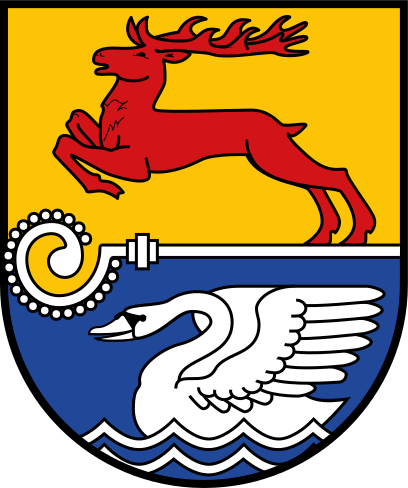
According to the legend, the antlers of the hunted stag were hung up in the completed church, as an eternal reminder of the vow. The monastery itself was dissolved in 1552 in the wave of the Reformation, and the monks departed. But the three signs of the story remained. When Doberan received its town rights in 1879, Grand Duke Friedrich Franz II granted the town arms bearing a stag, a crozier and a swan.
Linguists today say the name probably goes back to a Polabian personal name of the same root, dobry, which does indeed mean «good». In Bad Doberan, however, people prefer to stay with the swan. Whoever rides today on the narrow-gauge steam train Molli, running since 1886, from the minster down to the coast, passes Heiligendamm, where Duke Friedrich Franz I had the first seaside resort in Germany opened in 1793. That too began, they say in Doberan, with a good place.

Heimweer.be · Europees Erfgoed Bewaard

