
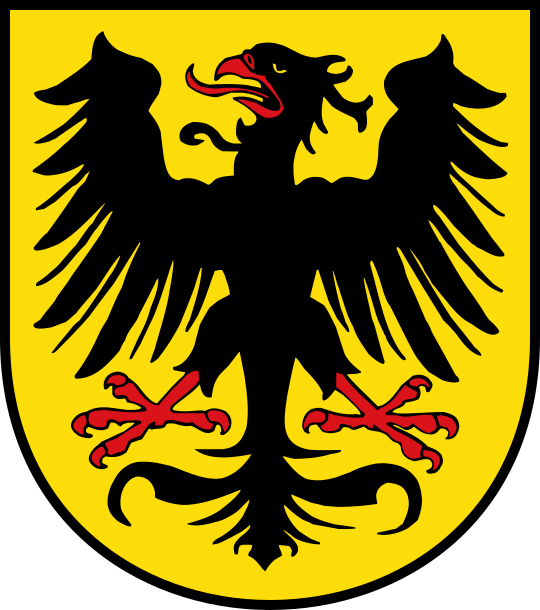
The Master and his Apprentice of Arnstadt


Arnstadt on the Gera, twenty kilometres south of Erfurt, holds the oldest documentary mention in all of Thuringia: on 1 May 704 the place appears as «Arnestati». Above the roofs stands the tower of Neideck Castle, sixty-five metres high, the last upright piece of a vanished moated palace. Yet the legend the people of Arnstadt tell most gladly does not hang on that tower. It hangs on two others: the west towers of the Liebfrauenkirche.


1 The oldest town in Thuringia
On 1 May 704 the Thuringian duke Hedan II granted estates at Würzburg to the Anglo-Saxon bishop Willibrord of Utrecht. That deed of gift names Arnstadt, Mühlberg and Großmonra — the oldest places in Thuringia and central Germany attested in writing. The original no longer exists. What we read is a copy made by the monks of Echternach in the late twelfth century, the Liber Aureus Epternacensis, kept today in Gotha.
The imperial abbey of Hersfeld held the manorial lordship of the town for centuries. In 1332 Abbot Ludwig II sold town and bailiwick to the counts of Schwarzburg, and Arnstadt became a residence town. Between 1553 and 1560 Count Günther XLI of Schwarzburg raised the moated palace of Neideck in Renaissance style on the foundation walls of a castle already mentioned in 1273. When Prince Anton Günther II died in 1716 the residence was moved to Sondershausen. The palace stood empty, served as stabling, and its stones were carted off to build bridges. In 1779 it partly collapsed. Only the tower remained standing; since 1999 it can be climbed again.
2 The master and his apprentice
Anyone who looks up at the two west towers of the Liebfrauenkirche sees at once that they do not belong together. The southern one is still late Romanesque, the northern already Gothic; art historians explain this by the difference in building date, somewhere around the middle of the thirteenth century. The people had another answer.
An old and proven master builder was given the commission for the towers, so the story runs, and handed the front tower to his young apprentice. The apprentice set to work with burning zeal. Both structures grew, and the whole town watched as though it were a contest. Plain and firm rose the master’s tower, sparing with ornament. But the apprentice poured his whole imagination into the upper storeys: an octagonal shaft, a wreath of gables, a roof of a lightness no one in Arnstadt had seen before. People stopped and stared, and it was the apprentice they praised.
The master let nothing show. The songs of praise for the young man poisoned him within. The work had long been finished when the apprentice at last demanded his wages in earnest. «Your tower has turned out well», said the master, «but it has one great fault. I shall show it to you up above.» Together they climbed to the highest window. The apprentice leaned far out to find the fault. «Here are your wages», said the master, and thrust him out. The apprentice was dashed to pieces on the paving. His little dog sprang after him without hesitating and stayed faithful to him in death as in life.
3 What the stone keeps
High on the north-west tower, says the legend, one still sees a man bending down and a dog. Inside the church, on the capitals of the columns near the high altar, there is a male figure set upside down with his garment flung upward, and beside it in the foliage the head of a dog. Johann Christian von Hellbach, who published a treatise on the Liebfrauenkirche and the nunnery in 1821, held that the figures on the tower were an echo of precisely these choir sculptures. He argued firmly against the attempt by the court councillor Joseph von Hammer to read the figures as Templar and gnostic signs.
Ludwig Bechstein, a Thuringian himself, took the story into his «Deutsches Sagenbuch» and honestly added that exactly the same is told of the towers of Naumburg and of many other churches. It is a migratory legend that attaches itself to every pair of unequal towers. In Arnstadt it found its best evidence, for here the difference stands literally in the stone. Bechstein also reported that the empty Liebfrauenkirche was an uncanny place and that spirits held their matins there at midnight. Whoever climbs the Neideck tower today looks out across the roofs at that unequal pair — and at the Neue Kirche, where an eighteen-year-old from Eisenach tested the new organ in 1703 and stayed four years.

Heimweer.be · Europees Erfgoed Bewaard

