
The Jerusalem Gate of Büdingen


Büdingen in the Wetterau still wears its complete late-medieval belt: a wall of red sandstone with twenty-two towers and half-shells, one of the best preserved town fortifications in Germany. Set into it stands the finest gate in Hesse, the Jerusalem Gate. Behind the wall lies the moated castle of the counts of Ysenburg. About all three the people of Büdingen tell their stories, and the oldest one begins with snow and soot.


1 The charcoal burner in the snow
Emperor Frederick Barbarossa, so they tell in Büdingen, was hunting one winter day in the wide forest east of the town. The hunt dragged on, the snow fell thick, and when the emperor at last let his horn fall silent he found he had lost his retinue. He wandered among the trunks until he saw smoke rising. Beside a smouldering charcoal pile stood a burner, black to the elbows.
The emperor asked the man the way to the castle. The charcoal burner had no parchment and no coal to write with, but he had his hands. He bent down and drew with two of his soot-blackened fingers two lines through the fresh snow: that is how the road runs. Barbarossa followed the lines and reached the castle before dark. In gratitude, the legend says, he gave the charcoal burner the land on which he had found him.
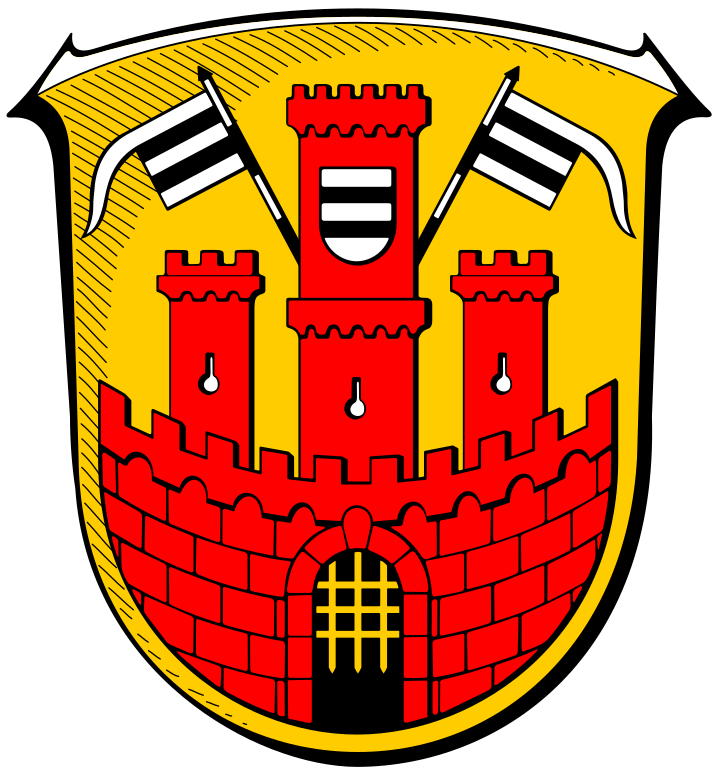
Out of those two fingers came a coat of arms. The noble house of Büdingen bore from then on a silver shield — snow-white — with two black bars across it. The counts of Ysenburg, who inherited the property in the thirteenth century, took over the bars, and to this day the town carries them in its arms.
2 The wall of Count Ludwig
The castle in the valley was a moated stronghold of the Hohenstaufen period, first mentioned in 1219, with an almost circular ring wall of bossed ashlar and a heavy keep. Around it the town grew, and around the town a first wall was laid in 1353. Count Ludwig II of Ysenburg thought that not enough. From 1476 he had a second and far mightier belt set in front of the old walls, fitted with twenty-two towers and half-shells. The work ran on until about 1510 and produced one of the most important late-medieval fortifications in Germany.
The showpiece was completed in 1503: the Untertor, two slender round towers of red sandstone, each with an outer diameter of 3.90 metres and walls narrowing from 1.60 to 1.20 metres. Eighteen arrow slits look out on the road. Above the passage stand the arms of Count Ludwig and his wife Maria of Nassau, the parapet panels carry fish-bladder tracery, and lion-shaped gargoyles jut from the cornice. A drawbridge once crossed the moat; during the restoration of 2003 its footing came to light again.
The oldest explanation of the gate name belongs to that building time. A son of the count, it is said, had been on pilgrimage in the Holy Land and brought back the drawing of a gate: the Sheep Gate of Jerusalem. On that model, so the story goes, the master mason built in Büdingen.
3 This is our Jerusalem
The second explanation is younger and more likely. Büdingen had turned Protestant as early as 1521, and in 1712 Count Ernst Casimir I issued an edict of toleration promising freedom of belief to the persecuted of every confession. Huguenots came from France, Waldensians from the Alpine valleys, Moravians and Inspirationists from every quarter. For them a new suburb of half-timbered houses arose by 1724 immediately in front of the Untertor.
Whoever came round the last bend after weeks on the road and saw those two towers standing knew that he had arrived. The refugees, they tell in Büdingen, knelt down before the gate, prayed, and said to one another: this is our Jerusalem. So the Untertor received its second name. As a fixed designation the Jerusalem Gate appears only about the middle of the nineteenth century, yet the town has never let the name go again. The gate was also called the Kreuztor, after the three crosses that stood beside the court linden.
The castle is still there, the princely family still lives in it, and the moat has silted up into a green belt. Whoever wants to pass from the outer into the inner castle courtyard goes through a gate guarded left and right by two stone figures with clubs. Every night at midnight, say the people of Büdingen, the two change sides. Only one who has never in his life told a lie can see it.

Heimweer.be · Europees Erfgoed Bewaard

