
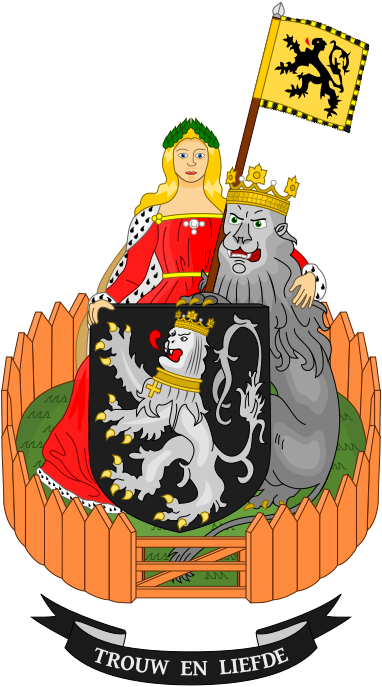
The Engelandgat


In old Ghent there was a street called the Engelandgat — a name that hinted something had once been broken open that should have stayed shut. The street is gone, but the story is not.


1 The siege
In the year 965, when Ghent was still a city of wooden houses and stone walls and Count Arnulf II ruled Flanders, the unthinkable happened: two kings attacked at once. The King of France and the King of England marched on Ghent from opposite directions and closed around the city like a fist around a throat.
The reason was trade — it was always trade. Ghent sat at the junction of the Leie and the Scheldt, and whoever controlled Ghent controlled the wool, the cloth and the money that flowed through it. Both kings wanted that money. Neither was prepared to leave it to the other.
The people of Ghent sat behind their walls and watched the fires of two armies stretching to the horizon. No relief was coming, no ally could help. The city had to negotiate or die.
2 The demand
Both kings sent envoys to the governor Diederik van Beveren. The French demanded tribute and loyalty. The English demanded more — something no city had ever allowed.
The English king, the legend tells, wished to ride through the city wall in person. Not through the gate — that was too ordinary. He wanted a hole knocked in the wall, a passage that did not exist, opened specially for him. And once inside he wished to sow grain by his own hand on the Vrijdagmarkt, in the heart of the city — the gesture of a conqueror showing that the ground beneath the feet of the people of Ghent belonged not to them but to him.
It was a humiliation so deep that the aldermen fell silent. But the alternative was worse. The English knight who delivered the demand made it clear: refuse, and Ghent would be razed. Every man, woman and child.
Diederik van Beveren bowed his head. The wall was breached between the Posteernepoort and the Torrepoort, and the English king rode through the gap his soldiers had made — triumphant, slowly, so that everyone could see.
3 The gap
On the Vrijdagmarkt the king sowed his grain. The kernels fell onto the cobblestones and never sprouted — but that was not the point. The point was the gesture, the message, the humiliation. Look, said the grain on the stones, this city is mine.
Afterwards the king withdrew, and the people of Ghent bricked the gap shut again. But the name stayed. The passage was called the Engelandgat from then on — the England Hole — and the whole neighbourhood between the Leie and the Houtleie became known as Ingeland. For centuries the name reminded the people of Ghent of the day their city was humbled by a king who did not even think their wall worth using.
Later the Engelandgat was renamed Akkerstraat and later still Rasphuisstraat. Chroniclers such as Marcus van Vaernewyck wrote the story down, and historians doubt whether it truly happened that way. But the people of Ghent are a folk who keep their wounds as memories. The gap has been bricked up, the street renamed, but the story of the day England punched a hole through the pride of Ghent — that has never been forgotten.
- The Buttermilk Bridge · Gent
- The Bleeding Hosts · Gent
- Stien and Lies · Gent

Heimweer.be · Europees Erfgoed Bewaard

